
About Us
The Life of St. Anthony of Padua
The young man watched in reverent silence as the bodies of five Franciscan missionary martyrs were carried in a solemn procession through the streets of the village of Coimbra, in the presence of the queen and a huge crowd. These holy men – Bernard, Peter, Otho, Accursius, and Adjutus – had journeyed to Morocco in North Africa filled with missionary zeal, eager to preach the gospel. Not only was their message rejected, but they had been tortured and brutally killed. Their bodies had been recovered and returned to Coimbra by some Christian merchants. Now, these first Franciscan martyrs were being honored with Christian burial. As the scene unfolded, the young man, Fernando Bulhom, realized he was facing a turning point in his life. As he pondered the ultimate sacrifice made by these brave Franciscans, his heart was on fire with love for Christ and he knew he was more than willing to accept anything – even a martyr’s death – to bear witness to that love.
Up until that time Fernando’s life had been quiet and uneventful. He was born in 1195 in Lisbon, Portugal. His parents, Martin and Mary Bulhom, were part of a wealthy, prominent family of the Portuguese nobility. Martin was a captain in the royal army.
After receiving his early education at the Cathedral School in Lisbon, Fernando had joined the Augustinian order at the age of fifteen. Two years later he entered the Augustinian monastery of Santa Croce in Coimbra, where for nine years he devoted himself to the study of Scripture and theology. It is likely that he was ordained a priest during this time. After the funeral of the Franciscan martyrs, Fernando received permission from his superiors to leave the Augustinians so that he could join the Franciscans and become a missionary. He was received warmly by the Franciscans, and joined the order in 1220. At this time Fernando Bulhom changed his name to the one by which he is known today – Anthony. That same year Anthony set sail for Morocco to begin his missionary work. However, he became seriously ill almost as soon as he arrived, so ill that he wasn’t even able to get out of bed, much less preach. Even after recovering, he was still so weak that he decided he must return by ship to Portugal. He was sent back home after only four months, his dream of preaching the Gospel in a foreign land shattered.
Anthony’s life then took another unexpected turn. On the return trip from Africa, a storm blew his ship off course to the east, and he was shipwrecked on the coast of the island of Sicily. He was taken in by the Franciscans at nearby Messina. From there he was sent to Assisi, where the fourth General Chapter of the Franciscans was being held in May, 1221. Anthony attended the General Chapter along with 3,000 other Franciscan friars, including the revered founder, Francis of Assisi. He hoped to catch on as a teacher at one of the friaries. But because his skill as a scholar was not known, he had a difficult time landing an assignment. Finally, Fr. Gratian, the Provincial of the region of Romagna, Italy, sent him to the quiet mountain hermitage of San Paulo near Forli. There Anthony worked for nine months as chaplain to the hermits, content to perform the lowliest duties of the kitchen and monastery.
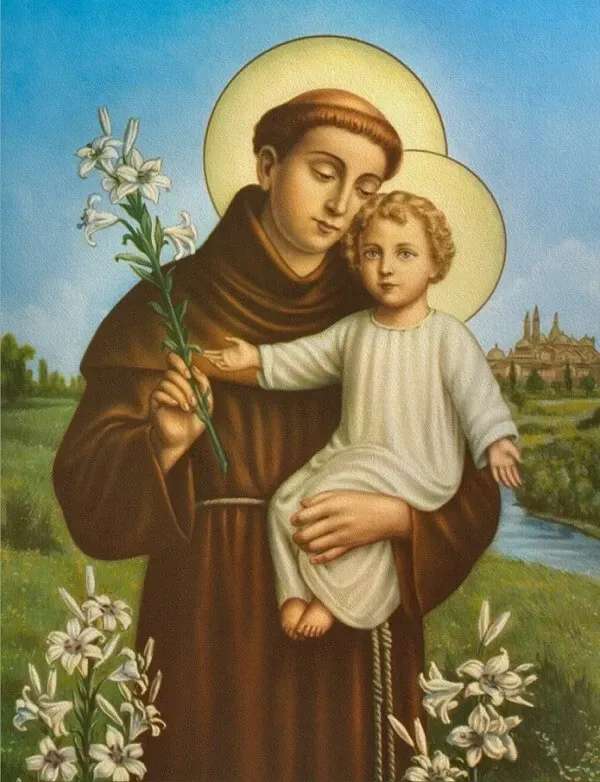
His brilliance was discovered quite by accident. One day Anthony went down the mountain into Forli on the occasion of an ordination. Before the ceremony began, it was announced that the priest who was to preach the sermon had become ill. The local superior asked the friars in attendance to volunteer to deliver the sermon. One by one each excused himself, saying he was unprepared. Finally, Anthony was asked. He, too, excused himself. But his superior ordered him in obedience to give the sermon. At first, Anthony spoke in a halting and reserved manner; but before long, filled with passion for the Gospel, he preached with such eloquence and learning that everyone in the church was amazed. When Francis of Assisi heard of this event, he gave Anthony a new assignment – to preach the Gospel throughout Italy. He was also appointed lector in theology to the Franciscans, the first in the order’s history. Anthony considered his calling to preach more important than his teaching work. He traveled tirelessly, making some 400 trips to both northern Italy and southern France. He attracted such great crowds that no church was large enough, and so he was forced to preach outdoors. Eventually, he needed a bodyguard to protect him from people who carried scissors in hopes of snipping a piece of his habit as a relic.
Anthony’s preaching was based on the Scripture, and his knowledge of the Bible was considerable. One of his surviving sermons includes no less than 183 references to the Sacred Scripture. He also preached against the sin of usury, the charging of interest on a loan, a practice that was common at the time. In fact, his preaching on this subject was so influential that the town of Padua passed a law in favor of debtors who could not repay their debts. To heretics he preached the positive message of Christianity rather than condemnation, and his sermons caused numerous conversions. It was said that, because of Anthony’s preaching, deadly enemies were reconciled, and thieves made restitution. His words were so powerful that, as one story has it, fishes lifted their heads above the water to listen as he preached to them.
After his morning Mass and sermon, Anthony and his helpers often heard the confessions of eager penitents for many hours a day, and even into the evening.
But as great a preacher as he was, Anthony believed even more strongly in the value of preaching by the example of his life. He lived in great simplicity and poverty, in imitation of Christ. “The ones who preach correctly are those who conform by their actions to what they announce with their mouths,” he once said.
Through it all, he never forgot the admonition of Francis to maintain an active prayer life. Even after the most grueling of days he spent many hours of the night in intimate, prayerful union with God.
In 1227 Anthony was elected Provincial of the Franciscans of northern Italy. The following year he journeyed to Rome, where he met and preached a sermon before Pope Gregory IX. The response to his words was so great that some in attendance later said it seemed the Pentecost experience had been repeated. Anthony was released from his duties as Provincial in 1230 to devote himself more fully to preaching. He took up residence near Padua, a town not far from Venice. As always, he threw himself into his preaching ministry and his intense prayer life with all his energy. This had the effect of sapping his strength, and within months he fell gravely ill. As death approached, Anthony received the last rites of the Church. As the sacrament was being celebrated he gazed upward with a smile on his face. When asked what caused him to smile he said, “I see my Lord.” Anthony died a short time later, on June 13, 1231.
Just one year later Anthony was declared a saint by his friend Pope Gregory IX, and June 13 was established as his feast day. At Padua a great basilica was built in his honor, and his body was buried there in 1263. St. Anthony of Padua was declared a Doctor of the Church by Pope Pius Xii in 1946. St. Anthony is considered a patron of the poor. Since about 1870 alms given to obtain his intercession have been known as “St. Anthony’s Bread.” He is also frequently invoked for the return of lost property, possibly because of an incident involving a novice who ran away with a Commentary on the Psalms that Anthony was using. According to the story, Anthony prayed for the return of both the novice and the Commentary. The novice soon returned with Commentary in hand, reporting that he had been persuaded by an apparition to return it.
Prayers of St. Anthony
Sermon of St. Anthony
Actions speak louder than words; let your words teach and your actions speak. We are full of words but empty of actions, and therefore are cursed by the Lord, since he himself cursed the fig tree when he found no fruit but only leaves. It is useless for a man to flaunt his knowledge of the law if he undermines its teaching by his actions. But the apostles “spoke as the Spirit gave them the gift of speech.” Happy the man whose words issue from the Holy Spirit and not from himself! We should speak, then, as the Holy Spirit gives us the gift of speech. Our humble and sincere request to the Spirit for ourselves should be that we may bring the day of Pentecost to fulfillment, insofar as he infuses us with his grace, by using our bodily senses in a perfect manner by keeping the commandments. Likewise, we shall request that we may be filled with a keen sense of sorrow and with fiery tongues for confessing the faith so our deserved reward may be to stand in the blazing splendor of the saints and to look upon the triune God.
Novena Prayer to St. Anthony of Padua
O Holy St. Anthony, gentlest of Saints, your
love for God and charity for His creatures,
made you worthy, when on earth, to possess
miraculous powers. Miracles waited on your
words, which you were ever ready to speak for
those in trouble or anxiety. Encouraged by this
thought, I implore you to obtain for me
(request). The answer to my prayer
may require a miracle. Even so, you are
the Saint of Miracles.
O gentle and loving St. Anthony, whose heart
was ever full of human sympathy, whisper my
petition into the ears of the Sweet Infant Jesus,
who loved to folded in your arms, and the
gratitude of my heart will ever be yours.
Amen.
Our Father, Hail Mary, Glory be.